
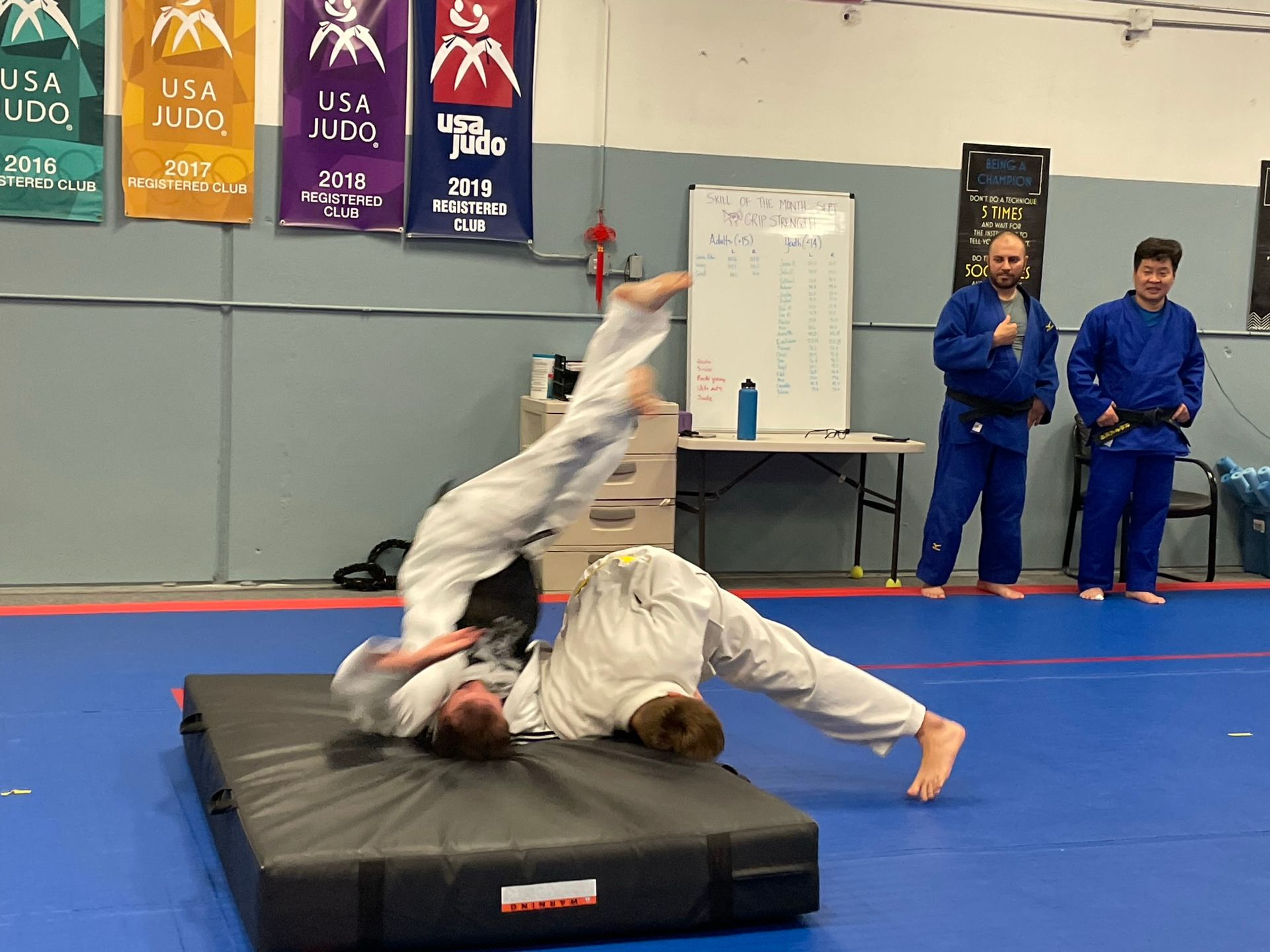
Judo turns balance, timing, and leverage into real-world self-defense you can practice safely and use confidently.
When adults look into Judo for self-defense, the first question is usually practical: will this actually work when things get messy, fast, and unpredictable? Our answer stays grounded in what we train every day. Judo is a system built around off-balancing, gripping, throws, and pins, which means you learn how to manage another person’s body without needing perfect conditions.
In Pasadena, life happens in tight spaces: parking lots, narrow sidewalks, crowded events, and those moments when you are carrying groceries or guiding a kid by the hand. We teach Judo with that reality in mind. You are not just collecting techniques. You are developing composure, posture, and movement habits that show up when you need them.
Just as important, our approach makes the learning feel doable. Judo rewards consistency more than raw athleticism. If you can show up, listen, and practice, you can get better, and you can get safer.
Why Judo works so well for adult self-defense
A lot of self-defense training focuses on what you do after a punch is already flying. Judo starts earlier. It teaches you how to control distance with grips, how to break someone’s posture, and how to stay balanced while someone tries to move you. That matters because many real conflicts begin with contact, grabbing, or shoving, not clean, cinematic strikes.
Judo also gives you options that scale. You can use a light touch to create space and leave. You can use firmer control to stop someone from pulling you into danger. And if you truly have to, Judo includes high-percentage takedowns and pins that can end a situation quickly.
For adults, another advantage is clarity. Judo is not a grab bag of tricks. It is a connected set of ideas: posture, base, leverage, and timing. Once those ideas click, you start seeing patterns everywhere, including in situations you did not expect.
The core self-defense skills we build in class
Balance and posture under pressure
Most people realize how much they rely on balance only after it is challenged. In Judo, balance is not just standing up straight. It is learning where your weight sits, how your feet connect to the floor, and how to recover when someone yanks, bumps, or crowds you.
We train posture like a skill, not a suggestion. You learn how to keep your hips under you, how to avoid leaning, and how to move without crossing your feet or overreaching. Those tiny details are the difference between staying upright and getting folded.
Grips, hand fighting, and control without panic
In self-defense, getting grabbed can create instant stress. In Judo, grips are normal. You learn how to keep your hands active, how to peel grips safely, and how to deny someone the angle they want. That practice turns “I froze” into “I know what to do with my hands.”
We also emphasize staying calm while someone is strong and persistent. That calm is trained. It comes from repeating the same entries and grip breaks until your body recognizes the problem and responds without drama.
Off-balancing that makes technique work
Throws are not powered by strength alone. They come from kuzushi, off-balancing. When you learn to shift someone’s weight onto a weak point, suddenly even a simple movement becomes effective. This is why smaller adults can throw bigger partners when technique is correct.
We teach off-balancing as a feel, not a formula. You learn to sense when someone’s weight is heavy on their heels, when they are stepping too long, when they are pulling instead of pushing. That awareness is a real self-defense asset because it helps you choose the right moment.
Safe falling so you can keep functioning
Self-defense is not only about what you do to someone else. It is also about what happens if you slip, trip, or get knocked down. Judo includes ukemi, the art of falling safely. We teach you how to absorb impact, protect your head, and recover your base.
This is one of those benefits adults do not fully appreciate until they feel the difference. Learning to fall with control reduces fear, and it makes practice safer. It also helps in everyday life, because falls happen outside the gym too.
Real-world situations where Judo shines
Judo is especially relevant in scenarios that involve grabbing, clinching, and close contact. That does not mean we pretend every situation looks the same. It means we train principles that show up repeatedly.
Here are a few situations we prepare you for in a realistic, skills-first way:
- Being grabbed at the wrist or sleeve and pulled off your line, where grip awareness and posture matter immediately
- A shove or chest-to-chest confrontation, where base, framing, and off-balancing can create space
- Someone trying to bear hug, tackle, or body-lock, where hip position and balance decide the outcome
- Slips and trips in wet parking lots or uneven surfaces, where breakfalls and recovery reduce injury risk
- Ground control moments, where holding a pin long enough to disengage can be the safest option
We keep the emphasis on control and exit when possible. Self-defense is not a sport match. The goal is to get home safely, not to prove anything.
How our training stays safe while still being practical
Adults want realism, but nobody wants avoidable injuries, especially when you still have work on Monday. Our classes are structured to build skill in layers. We start with fundamentals at a slower pace, then increase intensity as your control improves.
Safety comes from three habits we reinforce constantly: good partner communication, clean technique before speed, and tapping early when a hold is tight. We also pay attention to warmups that prepare joints and hips for throwing mechanics, because your body appreciates that, especially over 30.
We use progressive drilling so you learn the movement patterns without chaos. Then we add resistance gradually. That is how you build confidence that is real, not borrowed from a scripted drill.
What a typical adult Judo class feels like
If you have never trained before, the first class can feel like learning a new language with your whole body. You will sweat. You will laugh a little when your feet do something unexpected. That is normal, and it passes quickly.
A class typically includes warmups, breakfall practice, technical instruction, and partner drills. As you gain experience, you will also do controlled randori, which is live practice with agreed intensity. Randori is where timing and composure develop, and we keep it structured so it stays productive.
You do not need to be in perfect shape to start. Training is what builds the conditioning. Many adults notice better grip strength, stronger legs and hips, and improved mobility without feeling like they had to punish themselves to get there.
Judo for beginners: what you should focus on first
A lot of new students want to learn the “best throw” right away. We get it. Throws are exciting. But the fastest path is usually fundamentals: stance, movement, grips, and falling. Once those are in place, throws become easier and safer.
Here is the order we like for most adults starting Judo:
1. Learn basic ukemi so you can train confidently and recover quickly
2. Build a stable stance and footwork so you do not get off-balanced easily
3. Practice grip fighting concepts to control distance and direction
4. Drill a small set of high-percentage throws with clean entries
5. Add pins and transitions so you can control on the ground and disengage safely
That structure keeps your progress steady. It also prevents the common beginner trap of trying to muscle everything, getting tired, then assuming Judo “is not for me.” Most of the time, it is just a technique sequence issue.
Why Judo builds confidence that carries into daily life
Confidence from martial arts is different from hype. It is quiet. It shows up when someone crowds your space and you do not shrink. It shows up when you walk through a parking lot with your head up, scanning naturally, not anxiously.
Judo helps because it trains decision-making under pressure. You learn how to breathe while someone is pushing into you. You learn how to move your feet instead of locking up. Over time, you stop reacting emotionally to every bump or grab, and you start responding with skill.
We also see adults benefit mentally from having a consistent practice. Training gives you a place to reset. You leave class tired in a good way, the kind of tired that helps you sleep. And you can feel yourself improving week by week, which is honestly satisfying.
Judo in Pasadena: fitting training into real adult schedules
Most adults are balancing work, family, and the usual life logistics. That is why we keep training approachable and structured. You will make progress even if you train a couple times a week, as long as you are consistent and you practice with intention.
If you are looking for Martial Arts in Pasadena that prioritize practical body control and real skills, Judo in Pasadena is a strong fit because it meets you where you are. We keep fundamentals central, and we build intensity gradually so you can stick with it long enough to get the real benefits.
The key is choosing a schedule you can actually maintain. It is better to train twice a week for a year than to train every day for two weeks and disappear. We help you find that rhythm, and we keep you moving forward.
Take the Next Step
Building real self-defense skill is not about memorizing a long list of moves. It is about practicing a small set of principles until they show up automatically, and that is what we emphasize every time we teach Judo.
When you are ready to train with a clear plan and supportive coaching, we would love to help you get started at Champion Martial Arts & Fitness. If you want to feel what practical training is like in person, we can point you to the class schedule, walk you through what to expect, and help you choose a pace that fits your life.
Turn what you learned here into hands-on training by joining a Brazilian Judo class at Champion Martial Arts & Fitness.